

Türkiye’s advertising rules changed on 1 August 2026, and one part of that change is easy to check for yourself: open the Meta Ad Library, search Türkiye, and look at how influencer collaborations are labelled.
As of writing, roughly 5,600 live ads in Türkiye still carry only #işbirliği. The interesting part isn’t the count. It’s that many of these started running after the rule changed. A dentist promoting toothpaste, a haircare brand running the same creator twice, an electronics ad with what looks like a typo where “Reklam” should be: all launched in the weeks after 1 August, all using a label that stopped being sufficient on that date.
What the rule actually requires
Since the amendment to the Ticari Reklam ve Haksız Ticari Uygulamalar Yönetmeliği took effect, sponsored content needs the word “Reklam” or “Tanıtım”, plus a way to identify the brand behind it. #işbirliği, #sponsorlu and #ortaklık on their own no longer meet that bar. The label also has to be visible on first view without scrolling, in adequate contrast, ahead of other hashtags, and present on every frame of multi-frame content.
That last part is where several of the ads I looked at fail even when the right word is technically present. One streaming-service ad does include #reklam, but buried at the very end of a long caption, well below Instagram’s “… more” fold. A label that’s compliant on paper but invisible in practice appears to miss the point of the requirement.
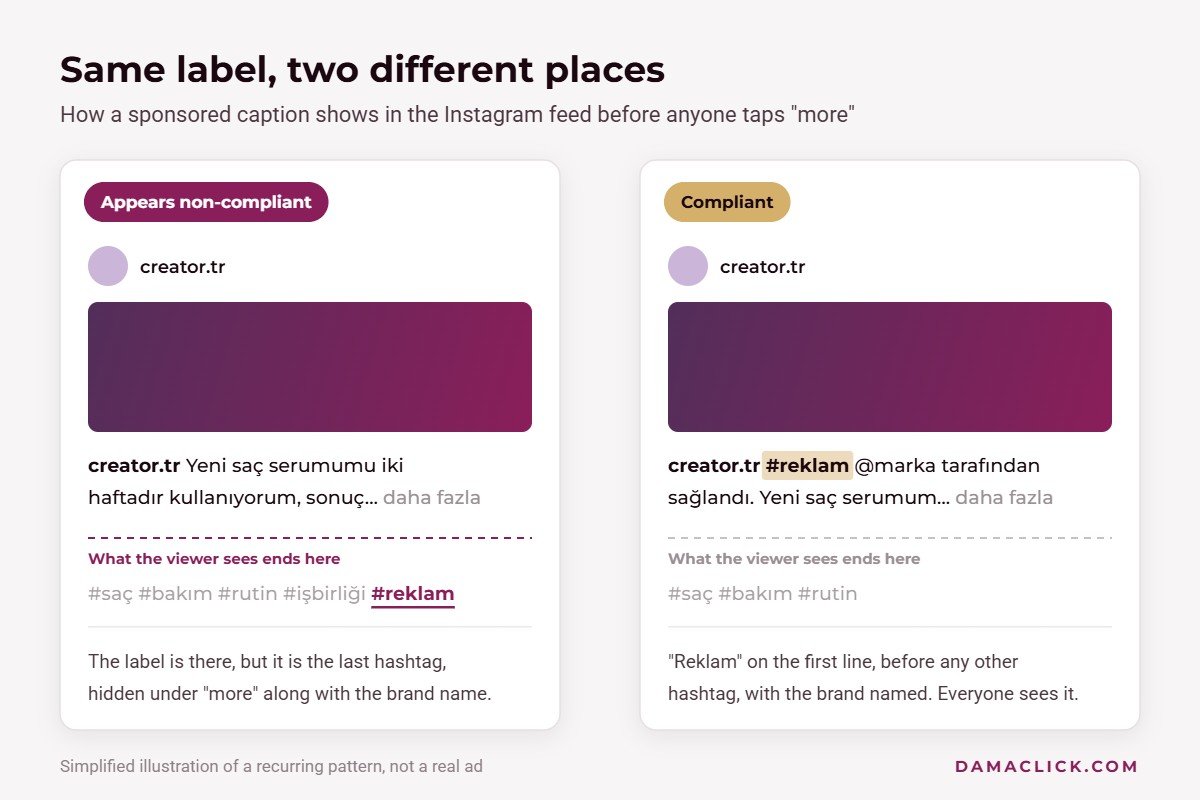
What compliant looks like
An ice-cream brand running the same campaign through two different creators opens both posts with #reklam, names the brand handle, and adds the approved phrasing “@marka tarafından sağlandı.” Same offer, two creators, same pattern both times. That reads like an agency working from a checklist rather than someone getting lucky twice.
Why this matters commercially, not just legally
A disclosure label in the first line, above the fold, isn’t just the compliant placement. A label buried at the end of a caption also hides the brand mention behind “… more”, so the compliant placement is the one people actually see. And because liability under this rule falls on the advertiser, the influencer and the agency independently, a brand doesn’t get to point at the creator and call it their problem.
If an agency runs influencer collaborations for you, ask directly whether they’ve updated the labelling. Don’t assume the old hashtag habit still holds.
The pattern is easy to verify yourself: open the Ad Library, search a competitor or your own account, and see which label is actually sitting in that first line.
This isn’t legal advice. If any of this applies to a campaign you’re running, have your own lawyer read the current wording against it.
Related: one of the examples above is a dentist, so the health-advertising rules in my teardown of dental ads in Türkiye apply to them on top of this one.