

One live ad in Türkiye has been promising “50% off all products” since February 2025. That’s about nineteen months of a sale that never ends, and as of this month it is still running.
Until recently that was mostly a credibility problem. Since 1 August 2026 it may also be a regulatory one.
What changed
The amendment to the Ticari Reklam ve Haksız Ticari Uygulamalar Yönetmeliği, in force since 1 August, sets a clear test for discount claims. The “before” price in a was/now discount must be the lowest price the product sold for in the preceding 10 days. Perishables and services can use the immediately preceding price. Sellers on several channels must use the price from the channel where the discount is actually running.
The logic is simple. A discount is a claim that the price used to be higher. If the “discount” has been running for a year and a half, the discounted price is the price, and there’s no earlier price for the percentage to be measured against.
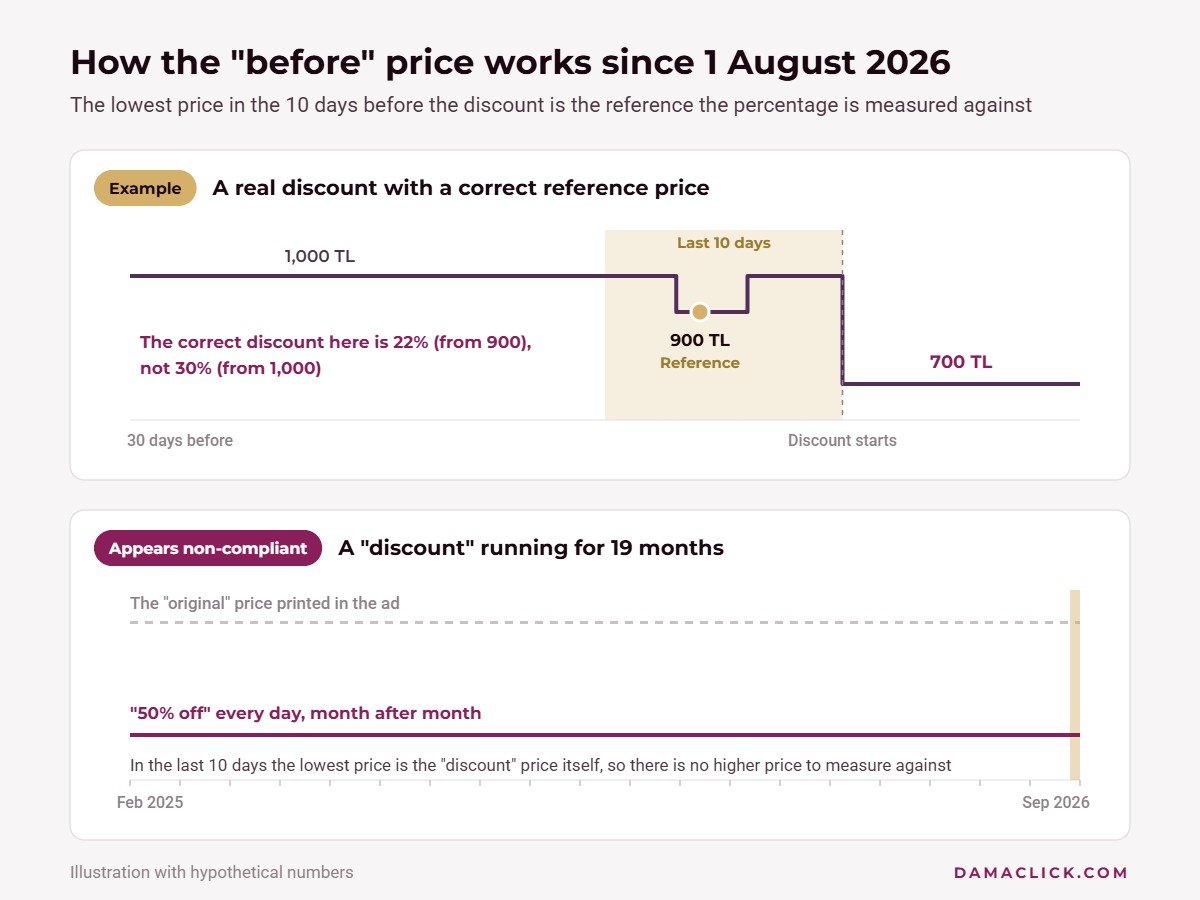
What the Ad Library shows
A search for indirim among active ads in Türkiye turns up a few patterns that are hard to square with the new rule:
- The “50% off everything” ad above, started February 2025 and still live.
- An “extra 20% off has started” ad, started December 2025. Nine months on, it’s still announcing that the sale has started.
- Two app-install ads offering “special discount opportunities”, running for roughly eleven months.
I can’t see these sellers’ price history, so none of these proves a breach on its own. But an ad that claims a discount continuously for most of a year appears to be exactly what the 10-day reference price was written to catch.
What the rule does not cover
A lot of the commentary misses this: a coupon code is not a was/now claim. Large marketplaces running “100 TL off with code X” are offering a conditional deal, not claiming the product used to cost more, so the 10-day rule doesn’t bite them the same way. Checking for the word indirim gets this wrong. The rule is about claimed savings against a previous price, not every mention of a discount.
One advertiser went the other way
A large department store is running the opposite of a fake discount: if something you bought goes on sale within 30 days, they refund the difference. That’s a price promise, not a price claim. It avoids the reference-price problem entirely and puts the risk on the retailer rather than the shopper. It’s also a stronger reason to buy than a “50%” nobody believes anymore.
What I’d do instead
- Run discounts as real, time-limited events with an actual end date, and let the price genuinely return afterwards.
- If the lower price is now simply your price, say so: “new lower price”, not “50% off”.
- Use conditional offers (codes, bundles, first-order deals) where they fit. They don’t make a previous-price claim.
- Keep a record of your prices across channels, so you can show what the reference price was if you’re ever asked.
Fines for internet advertising in Türkiye now run to roughly 8.6 million TL, and they apply to the advertiser, the influencer and the agency separately. The Advertising Board issued about 218 million TL in penalties in the first seven months of 2026. “Everyone does it” is an expensive assumption.
This isn’t legal advice. If you’re running discount campaigns in Türkiye, have your own lawyer read the current wording against your ads.
Related: the same amendment also changed the influencer-labelling rules. See why #işbirliği doesn’t work anymore.